New self-declaration process helps artists, rights holders, and platforms improve transparency around AI-generated music
Artificial Intelligence is now part of the music industry’s daily reality. As artists and producers adopt new tools, digital platforms are also updating their requirements. In response, ONErpm has introduced a new step during the upload process: artists must now indicate whether generative AI was used in the creation of a track.
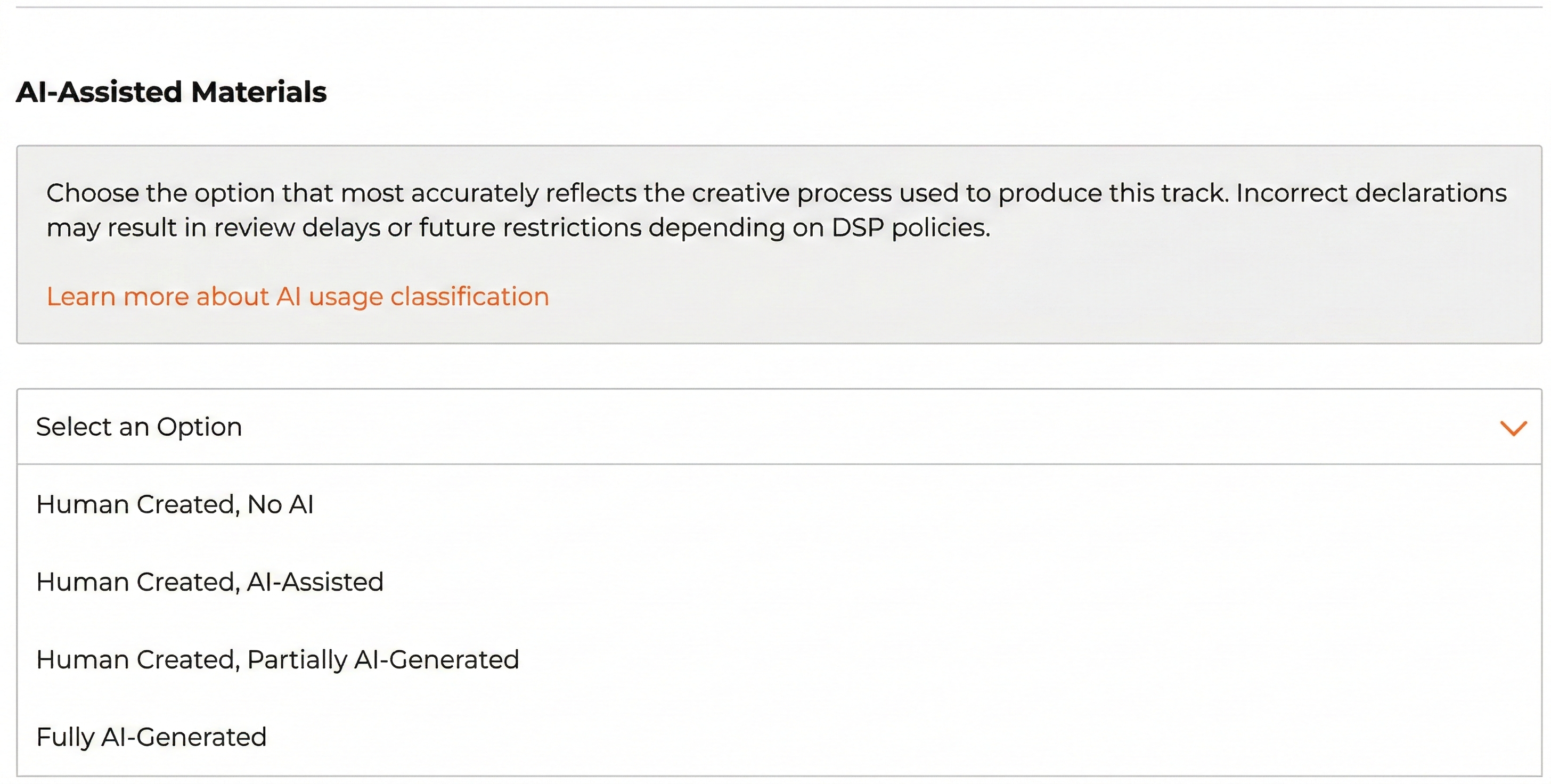
This update supports transparency and aligns with evolving DSP policies. When uploading a release, artists must identify whether a track was created entirely by humans, developed with AI assistance, partially generated by AI, or fully generated by AI. The goal is not restriction. It is to improve clarity, support compliance, and help prepare catalogs for future market changes.
At this time, all tracks remain eligible for monetization, regardless of AI usage. Royalties are not affected. The declaration is informational only.
The 4 Levels of AI Usage
During upload, artists will find four options. Each category reflects a different level of AI involvement in the creative process.
Human Created, No AI
This category applies to tracks made entirely by humans. All creative elements — including lyrics, melody, and composition — come directly from the artist.
Traditional studio tools such as DAWs, effects, and standard virtual instruments do not count as AI here. If a track was created without generators or AI-based composition tools, this is the correct option.
Human Created, AI-Assisted
This category applies when AI supports the process, but the artist remains the main creative decision-maker.
AI may suggest ideas, analyze sound, or assist with mixing, mastering, or noise reduction. However, the artist still defines the final work.
Human Created, Partially AI-Generated
This option applies when AI generates parts of the music or lyrics, and the artist then edits, develops, selects, or arranges them into a final composition.
The creative role of AI is more significant here, but authorship and artistic decisions still remain in human hands.
Fully AI-Generated
This category applies to tracks created mainly through AI prompts, with minimal artistic input beyond the original command.
In these cases, the core music, lyrics, or vocals are produced by a generator, and the human role is limited to prompting and exporting the result.
Why This Matters
The music business is moving quickly, and AI is now part of that shift. Some streaming platforms already require distributors to identify AI usage in order to classify content more accurately.
To meet these standards, ONErpm’s new self-declaration system gives artists and rights holders a simple way to report how a track was made. This approach helps protect the long-term integrity of catalogs while keeping distribution workflows aligned with current industry expectations.
A Simple Rule: Be Honest
When selecting an option, artists should focus on how the creative content was generated, not only on which tools were used.
It is also important to note that DSPs and technology partners are developing automated systems that can identify AI-related characteristics in audio. For that reason, honest declarations are the best way to ensure fair treatment and prepare for future policy changes.
Step-by-step: How to Select the Correct AI Usage Level On ONErpm
Learn more about ONErpm rules for distribution in our FAQ.
ONErpm. Music Is Power. Amplify It.